Why Is My Foot Itchy and Peeling?
A Quick Checklist for Dry Skin vs. Fungus
Why isn’t the lotion working? Because you might not be dealing with dry skin at all.
At Cypress Foot & Ankle Center, we frequently treat patients who have spent months battling what they thought was severe dry skin, only to discover they actually have a stubborn fungal infection, commonly known as Athlete’s Foot(Tinea Pedis).
Are you dealing with standard dry skin or something more stubborn? This quick checklist can help you evaluate your symptoms and realize when it’s time to see us.
The Dry Skin vs. Fungus Checklist
Mistaking a fungal infection for dry skin (Xerosis) is incredibly common because the two conditions look remarkably similar to the untrained eye. Treating them incorrectly can fuel the infection and make your symptoms significantly worse.
To start, it’s best to focus on where the peeling is happening and how it feels.
1. Check Between the Toes
- Dry Skin: Rarely occurs naturally between the toes.
- Fungal Infection: This is a red flag. Peeling, cracked, or macerated (white, soggy) skin between your toes is almost always a fungal infection.
- This area is naturally dark and moist, the perfect environment for fungus to thrive. Applying thick lotions between your toes traps the moisture, feeding the fungus and worsening the infection.
2. The “Moccasin” Pattern
- Dry Skin: Usually appears as generalized flaking across the heels and soles that improves slightly after applying moisturizer.
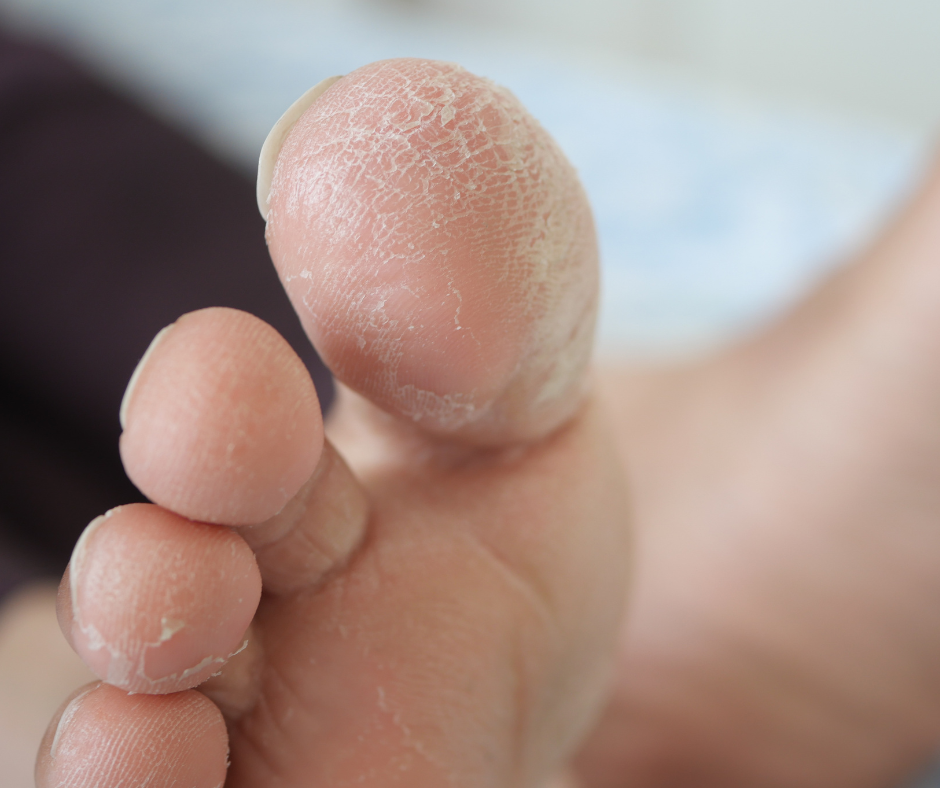
- Fungal Infection: Look closely at the pattern. A specific type of athlete’s foot covers the sole and wraps around the sides of the foot, looking almost like a low-cut slipper. It is often presented as dry, silvery scales resting on a base of red, inflamed skin. If your lotion isn’t touching this “moccasin” pattern, it’s likely fungal.
3. Evaluate the Itch
- Dry Skin: Feels rough, tight, and occasionally “scratchy.”
- Fungal Infection: The itch is usually intense, persistent, and often described as a raw, burning sensation. Patients frequently report that the burning itch is most severe right after taking off their socks and shoes at the end of the day.
Important Note: If you have been diagnosed with diabetes, any break in the skin, regardless of the cause, puts you at severe risk for dangerous secondary infections. You require specialized diabetic foot care and should never attempt to self-diagnose or self-treat foot wounds at home.
Why Over-the-Counter Creams Often Fail
If you suspect you have a fungal infection and have already tried drugstore antifungals without success, do not give up. Fungal Infections on the feet are notoriously stubborn for a few reasons:
- Weak Formulations: Many over-the-counter (OTC) creams are too weak to penetrate the thick, callused skin (stratum corneum) on the bottom of your foot.
- Fungistatic vs. Fungicidal: Many drugstore options only stop the fungus from growing temporarily (fungistatic) rather than destroying the organism entirely (fungicidal).
- Nail Involvement: If the fungus has spread to your nails, topical creams alone will rarely work. Toenail Fungus requires specific, advanced treatments to penetrate the hard keratin shield.
The Professional Solution
Depending on your specific condition, we can utilize prescription-strength keratolytic to safely dissolve thick calluses, allowing high-potency antifungal medications to finally reach the infection. For stubborn cases, oral medications may be prescribed to clear the fungus from the inside out.
Whether you’re experiencing pain or simply seeking preventative care, Cypress Foot & Ankle Center offers a wide range of services to address all your foot and ankle needs. While we focus on nonsurgical treatments, our team also provides advanced surgical procedures when necessary, using the latest technologies to ensure superior outcomes. Call (281) 377-4040 or contact us online!